

A step-by-step guide for busy homeowners ready to transform their space without losing their minds.
Let me guess the scenario.
It’s 10:30 PM on a Tuesday. You’ve had a long day at work, the kids are finally asleep, and instead of relaxing, you’re three hours deep into a Pinterest scroll hole labeled "Dream Kitchen." You have fifty tabs open on your laptop—half are tile samples, the other half are horror stories about contractors ghosting homeowners.
You know your home needs a change. Maybe the layout isn't working for your growing family, or maybe your 1990s bathroom is finally driving you up the wall. You’re ready for a transformation, but you’re also incredibly busy. The sheer volume of decisions involved in home renovation planning feels completely paralyzing before you’ve even swung a hammer.
If that sounds familiar, take a deep breath. You are not alone.
As an interior designer, I meet so many homeowners who are stuck in the "dreaming" phase because they are terrified of making an expensive mistake in the "doing" phase. The good news? There is a roadmap out of the overwhelm.
If you’re ready to stop scrolling and start planning, here is a simplified, step-by-step guide to getting started.
Step 1: Define the "Why" (Beyond Pretty Pictures)
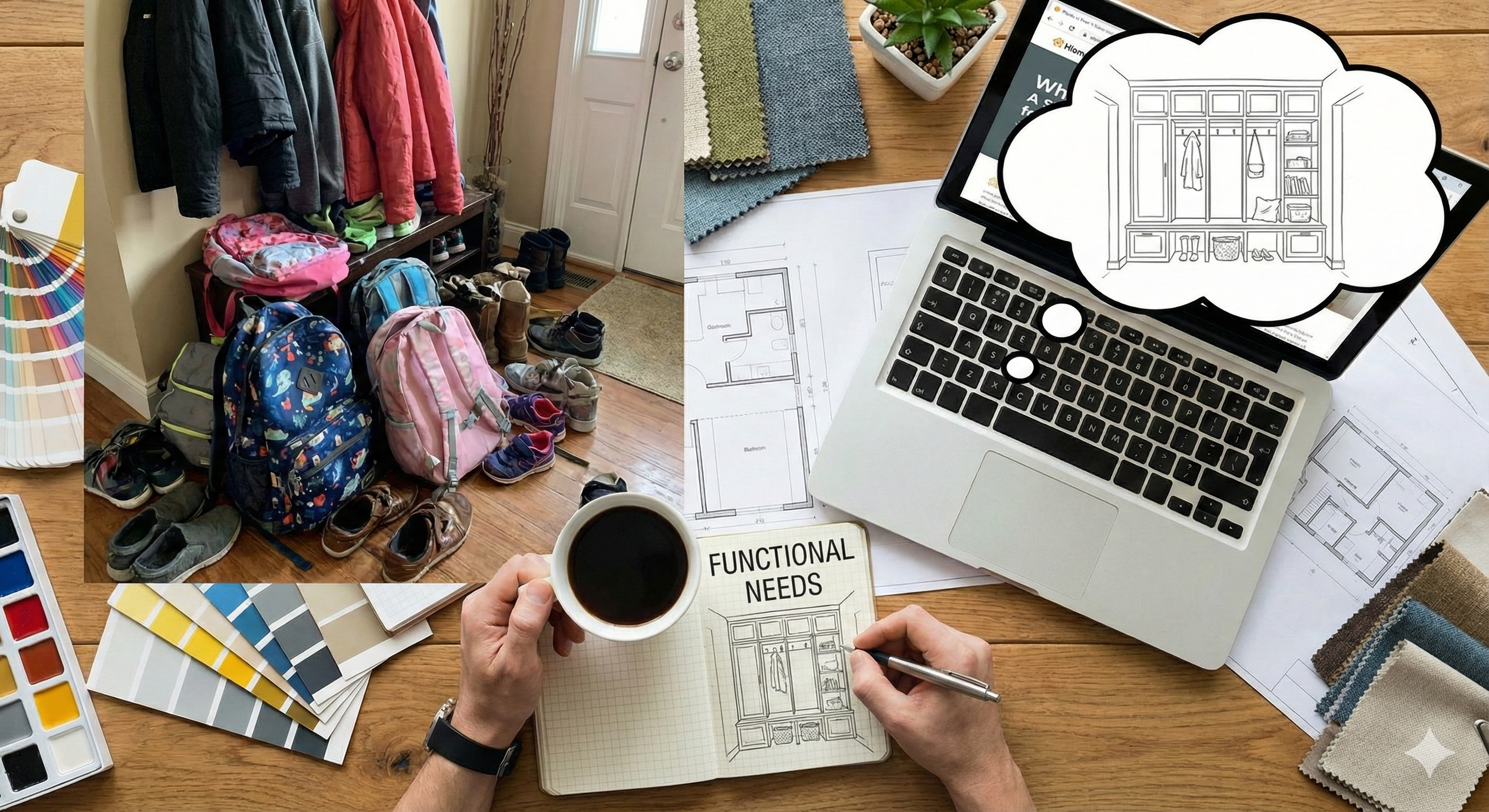
Before you pick out a single paint swatch or fall in love with a marble countertop, you need to dig deep into function.
Make it stand out
It’s easy to get caught up in aesthetics, but a beautiful room that doesn’t work for your lifestyle will frustrate you within a month. Before thinking about how you want the space to look, define how you need it to feel and perform.
Ask yourself these (hard) questions:
What are the biggest pain points in my current space? (e.g., "There’s nowhere to put backpacks," or "The kitchen bottleneck drives me crazy when cooking dinner.")
How does my family actually live versus how I wish we lived?
What are my non-negotiables? (e.g., "I absolutely need a soaking tub," or "We require durable, pet-friendly fabrics.")
Smart space planning starts with understanding these daily realities. Write them down. This list becomes your North Star when difficult decisions arise later.
Step 2: The Honest Budget Conversation
This is usually the least fun part of the process, but it’s the most crucial. You cannot effectively plan a renovation without a realistic financial boundary.
Many homeowners base their budget on what they hope things cost, rather than current market realities. Be brutally honest about what you are comfortable spending.
Pro-Tip: Once you have your number, shave 15-20% off the top right away. Put that money into a separate "contingency fund." In renovation, surprises happen—behind-the-walls electrical issues, shipping delays, sudden material price jumps. Having that buffer will save you dozens of sleepless nights.
A clear budget doesn't limit creativity; it actually guides it. It helps us know where to splurge on impact pieces and where we need to be clever with cost-saving alternatives.
Step 3: Curing the "Pinterest Fatigue"
Gathering interior design inspiration is fun, but it can quickly lead to decision fatigue. You might have a board filled with ultra-modern minimalist living rooms and cozy, cluttered English cottages.
It’s time to edit.

Look at your saved images critically. Are you seeing a pattern? Are you consistently drawn to warm wood tones? Do you hate clutter? Do you love bold pops of color, or are you essentially a "fifty shades of beige" person (which is totally fine!)?
Try to narrow your focus down to 3-5 images that truly represent the vibe you want. This curated vision will help communicate your style clearly to potential contractors or designers.
Step 4: A Reality Check on Timelines
If you take one thing away from this post, let it be this: HGTV is not real life.
Those shows where a whole-house gut renovation happens in six weeks? That’s TV magic. Real renovations take time, especially now. Permitting can take months depending on your municipality. Custom furniture often has 12-16 week lead times. Good contractors are booked out months in advance.
If you need your renovation finished by a specific date (like hosting Thanksgiving dinner), you need to start planning months earlier than you think. Setting realistic expectations for your renovation timeline is the key to maintaining your sanity during the process.
Step 5: Build Your Team (And Stop Doing It Alone)
You are busy. You have a job, a family, and a life. Do you really have the bandwidth to become a part-time project manager, procurement specialist, and construction supervisor?
The biggest mistake busy homeowners make is trying to white-knuckle the entire process alone.
A successful renovation requires a team: contractors, tradespeople, and yes, a professional advocate for your vision. This is where an interior designer comes in.
We don't just pick pretty pillows. We are experts in functional home design, we speak the language of contractors, we know where the budget pitfalls are hides, and we filter the thousands of decisions down to a manageable few for you.
The Next Step
If reading through this list made you feel a little lighter, great. If it made you realize just how much work is ahead, that’s okay too. Recognizing the scope of the project is the first step toward managing it.
If you’re ready to move from "overwhelmed" to "excited," I’d love to help lift that weight off your shoulders.
Let’s take that jumbled Pinterest board and turn it into a cohesive, actionable plan for your home. Schedule a call with us today, and let’s discuss how we can bring your vision to life—without the stress.
